Sunday, October 16, 2016

Rice, my Comfort Food

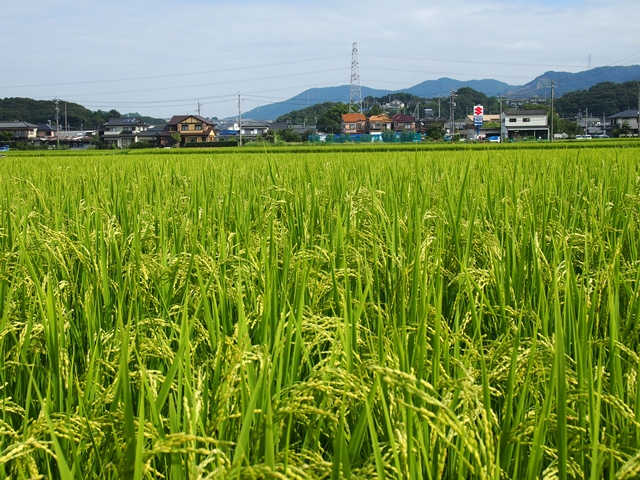
Bob and I enjoyed a leisurely walk one Saturday morning in September through rice fields that were ready to be harvested.  The typical growing season in our area is April or May to September or October.  We arrived in Japan in time to see the rice being planted, and now it is harvest time.
We talked to one farmer who said his field yields about 500 kilograms of rice each season.  It is typical for a farmer to have one small field (one and a half acres).
When I was a young child, I hated rice!  In high school, when families from Vietnam moved to my home community and served rice at every meal, I developed a taste for it.  When I lived in Palestine, rice was my "comfort" food.  If I had a challenging day at work, Bob would turn on the rice cooker!
Bob and I don't eat rice nearly as often as the typical Japanese person--once or twice a week on average--but rice is still one of my favorite foods.  Like many Asians, I prefer the short-grained sticky rice to the long grained or brown rice even though there's no comparison in nutritional value.
To better understand my students' rice-eating habits, I did an informal survey with one of my classes last week.  Here's what I found out:

  • 22 out of 24 students eat rice every day.
  • 6 students eat rice 3 meals a day, while 15 eat it twice a day.
  • 10 students eat less rice now than in high school, while 5 students eat more now.
  • Not all students know how much rice their family buys every month.  Most think it's 10 kilograms, a few think it's 20, and a few think it's 5.  I told them to ask their parents for homework!
  • 6 of the 24 know someone who has a rice field.

What does rice cost in Japan?  It isn't cheap.  According to this photo in our local supermarket, a 10 kilogram bag costs anywhere from 27 to 49 U.S. dollars (equivalent).  The map on the bag indicates which part of Japan the rice comes from.  (There is a ban on importing it from abroad.)  We've asked different people for their rice preferences, and we've gotten as many different responses.
That's it for today's rice trivia!  It's time to go eat some rice!


Sunday, October 2, 2016

Friends Past and Present

A great joy of being in Japan has been reconnecting with old friends and students.  In 1979, after graduating from high school, I spent a summer in Japan.  From 1992 to 2000, while teaching ESL at Eastern Mennonite University, I had numerous Japanese students.  This year I have had the privilege of seeing a few old friends and students, along with meeting their spouses, children, and grandchildren.  Bob and I were treated royally on each visit, and each visit was truly a pleasure!  Here are my old host parents, Kohei and Seiko Tanaka.  She taught me Japanese dance and language;  he and I had countless discussions.  I helped their two young children, Hiroko and Toyota, with their English.  Mr. Tanaka visited us in Archbold, Ohio, later that year.


Here's Sandy Liechty.  She and her husband Carl arranged for my summer stay in Japan.  I stayed with them and their children Georgia and Chris on the weekends.  We went to church together, played Monopoly together, and had countless discussions about God, faith, and Japanese culture. 

This is my dear friend, Megumi Iwaki, who befriended me that summer.  She took me all around the area on day trips, and I got to know her sister and parents.  She then spent time with my family in Archbold.

This is another dear friend, Kimie Ojima, who stayed with my family in Archbold for a number of weeks one summer.  My mother and Kimie have stayed in touch all these years, sharing Christmas letters.

And now for my students from Eastern Mennonite University.  Bob and I saw the first two while in Tokyo this summer.  Maki Nagai, a nurse, is currently working in Rwanda.
 Ryota Kuga, runs a guest house in Tokyo.
 Next Bob and I went to Hokkaido, Japan's northernmost island, where we saw another group of former students of mine, each of whom hosted us overnight or for meals.  First we visited Hanayo Morimoto, who teaches English.
Next we saw Hiromi Katakawa (and her husband Brad Kipfer), who went to Eastern Mennonite Seminary, and Sayaka Sugawara, an English teacher.
Lastly, we spent two days with Yuji Saeki (and his wife and daughter), who is a counselor, and his sister, Izumi (and her two children), an English teacher.  It was a wonderful family affair!


There's so much I could say about each visit, so many photos I could share.  But suffice it to say it was truly a blessing to re-connect with each person.  And I thank each one for his or her hospitality and warmth.  Now we are all back in touch, either by phone, letters, email, or Facebook!

Saturday, August 27, 2016

Our Cozy Ghetto Abode

Is it an oxymoron to say that our abode in the ghetto is cozy?  When we first moved in, we felt a bit claustrophobic and termed our new surroundings "the ghetto."  We live in a huge danchi--a group of apartment buildings.  There are 25 buildings in our city block, with about 750 apartments--one, two, and three-bedroom.  Beyond our block, there are many more danchi.  Hence, the term ghetto.
 There's an elementary school within this city block, so there's a playground, and some buildings are identified with animals.  Our building has the horse, with elephant and gorilla nearby.
After what Bob calls "the Cynthia touch," our apartment is now cozy in its own way.  We are still lacking wall art and decor, but for the moment, maps suffice.
We have three bedrooms, although two are too tiny for a bed.  My "office" is 8 ft. x 8 ft., with a hand-me-down love seat, where meditation and computer time happens each morning.
Bob's studio is 11 ft. x 7 ft, just enough room for a table to paint on and the electric keyboard we found at a second-hand store called "Hard Off!"

Our kitchen and adjacent bedroom is where we spend most of our time.  It's the only part of the house with AC and heat.  The university gave us two beds that were each four feet wide, taking up most of the 11 ft. x 8 ft. room.  It took about eight weeks to get a full-sized bed, a big improvement in our life.


Because our bedroom is the only room with temperature control, it also serves as our living room.  Two chairs and a coffee table help make it functional.
The bathroom set-up in Japan is wonderful, with a separate room for the toilet, the bath, and the sink and washing machine.  Bath water is heated and filled with a digital control.  A voice recording and music comes on when it's ready.  The Japanese bath is superb!
The kitchen is a happening place, as the homemade bread and cinnamon rolls attest to.  Though we don't have an oven, Bob learned to use the small microwave's convection oven for baking.  Every time he makes bread, about twice a week, he gets a big "YUMMY" from me!


Having dinner guests seemed impossible at first with nowhere to sit except at the kitchen table, but once we got over the fact that our dinner guests would be seeing our bedroom/living room while they ate,  we realized that we CAN entertain.  Folding chairs, good food, conversation, and our favorite dice game "Quixx" make for a fun evening.  Life in Japan is challenging, but life is also good!


Saturday, August 13, 2016

A Break from the Heat

With temps and humidity in the 90s, our day trip to Gandate Park was a welcome break from the sweltering heat.  Thanks to our friend Reiko, we were able to experience greenery unlike anything we've seen since our arrival.  Our 12-hour day trip began with lunch at a soba noodle restaurant overlooking a river.  It could not have been lovelier.

After lunch, we headed to a watering hole where the icy water of the Hida River refreshed us.  Bob could hardly believe I took the plunge so quickly, since I'm usually timid around freezing cold water.

Next was a walk through one small section of Gandate Park, where a volcanic eruption created Mt. Ontake 54,000 years ago.  Waterfalls fill the park, and each one we saw (and listened to) was stunning.  The rainbow over the last waterfall we visited was an added gift.


After four months in Japan, we finally got into an "onsen," a public bath--Japanese style--no clothing allowed.  Men and women have separate baths with indoor and outdoor pools of natural hot spring water.  It felt so good!  We then ended our day with a stop in Gero, a tourist town famous for its hot springs.  Throughout the charming downtown area, there are foot baths, where you can stop and soothe your feet in the hot waters.  Heavenly!